
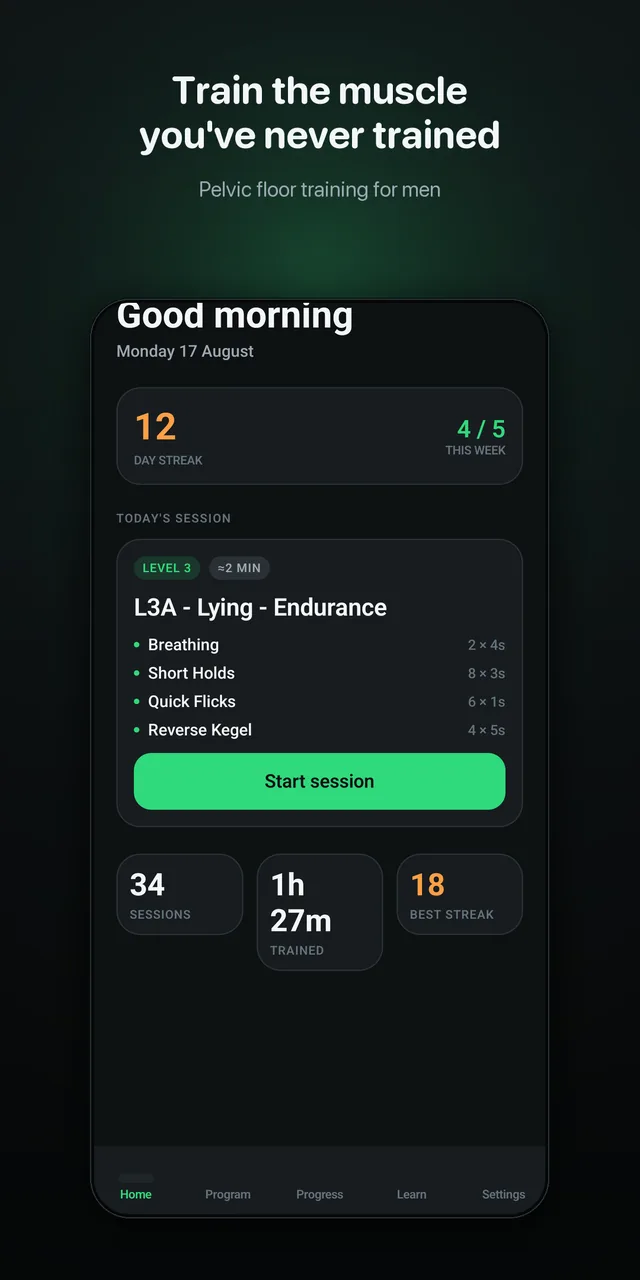
You get two sessions a day. Session A is the longer, endurance-biased one. Session B is shorter and biased toward speed and control. Most take under five minutes. If you only have time for one on a given day, do Session A.
The shape of a session
You get two sessions a day. Session A is the longer, endurance-biased one. Session B is shorter and biased toward speed and control. Most take under five minutes. If you only have time for one on a given day, do Session A.
Every session opens with breathing and ends with a release. That is fixed, at every level, from day one. Everything else in between changes as you progress.
The six exercise types
Breathing. Four seconds in, four seconds out, low into the belly. This is not filler. It sets your breath pattern before any load arrives, which is the direct countermeasure to the most common technique error in the whole program: holding your breath while you squeeze. Let the floor soften as you inhale, and lift as you exhale. Being straight with you, the exact four-second cadence is not a clinical parameter. It is a comfortable resting breathing rate and nothing more. Making breathing work mandatory rather than optional, though, is a considered call, supported by de Oliveira 2026, which found pelvic floor training paired with diaphragmatic breathing outperformed the same training done alone.
Quick Flicks. One second on, two seconds off. Snap the muscle up and let it drop completely. These train the fast, reflexive response, the one that has to fire the instant you cough, sneeze or lift something. Speed and clean release matter here, not force. Milios 2019 found that combining fast contractions with slow ones beat slow contractions alone, which is why flicks appear in every level rather than being an add-on.
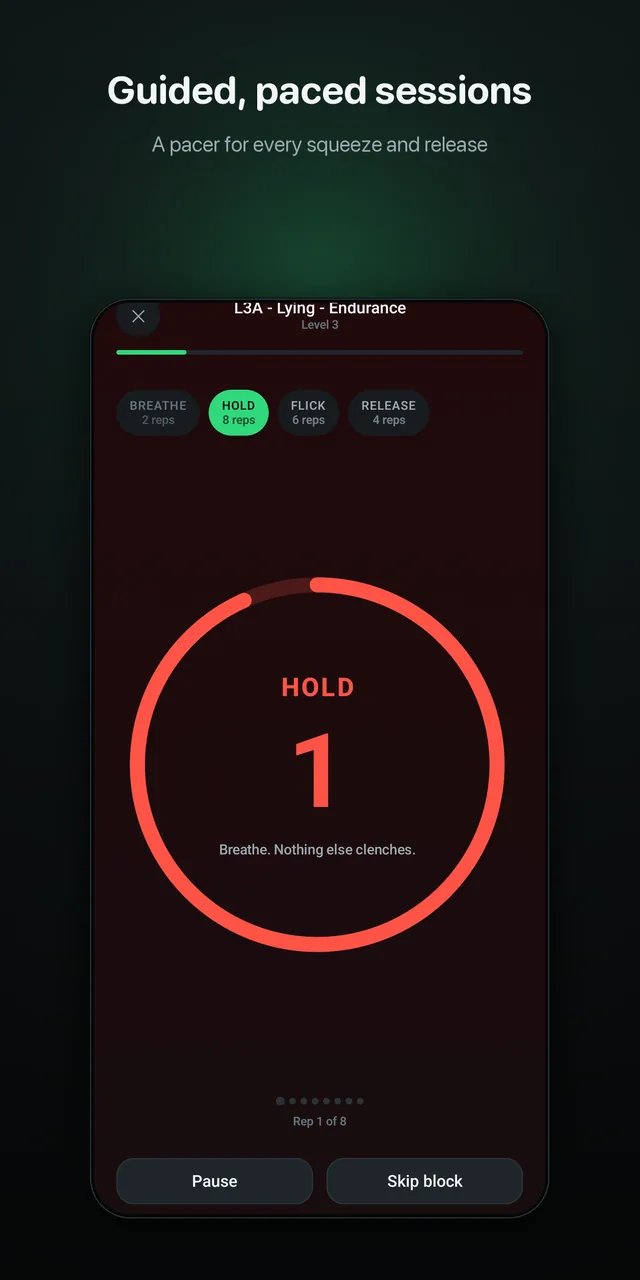
Short Holds. Two to five seconds of steady contraction, with a longer release after each rep. This is the entry point for endurance work in the early levels. Keep breathing through the hold. If the contraction fades halfway, that is your ceiling for the day and it is fine.
Long Holds. Six to ten seconds, with at least equal release time after each one. Ten seconds is the hard ceiling and nothing in KegelPro will ever ask for more. No published trial or professional protocol prescribes longer holds, and longer holds mostly teach people to hold their breath and recruit the wrong muscles. Back off if the hold starts to shake.
Elevator. A graded lift in stages, a hold at the top, then a controlled descent, rather than an all-or-nothing squeeze. This trains proprioception and control, not maximum force, and it unlocks later in the program because it needs skill you will not have in the first few weeks. Dorey 2004 included submaximal work of this kind, lifting to roughly half of maximum, in the home program that our exercise selection draws from.
Reverse Kegel. A gentle downward release and softening, held for a few seconds. Not a push, not a strain, and never bearing down hard. This closes every single session. Relaxation is half the job, and it is present from level one rather than unlocked as an advanced feature.
Why the order matters
The sequence is deliberate. Breathing first, load in the middle, release last. Within a session, two hold blocks of the same type never run back to back without something else in between, because fatigued reps are sloppy reps and sloppy reps teach substitution.
The rest phase after each repetition is labeled "release" rather than "rest" for the same reason. It is a working part of the exercise. Every hold gets at least as much release time as contraction time, and in the early levels a little more.
Volume, and why it is capped
Daily contraction volume runs from under twenty in the first week to around forty-five at the top of the program, across both sessions. That is deliberately conservative. Professional guidance commonly targets more, and the high-intensity arm in Milios 2019 ran well above it safely, so the ceiling here is not a safety edge. It is an adherence decision: the dose people actually complete beats the dose that looks impressive on paper. Dorey 2004 lost roughly four in ten participants partly to the burden of daily exercises, and adherence, not dose, is the usual reason home programs fail.
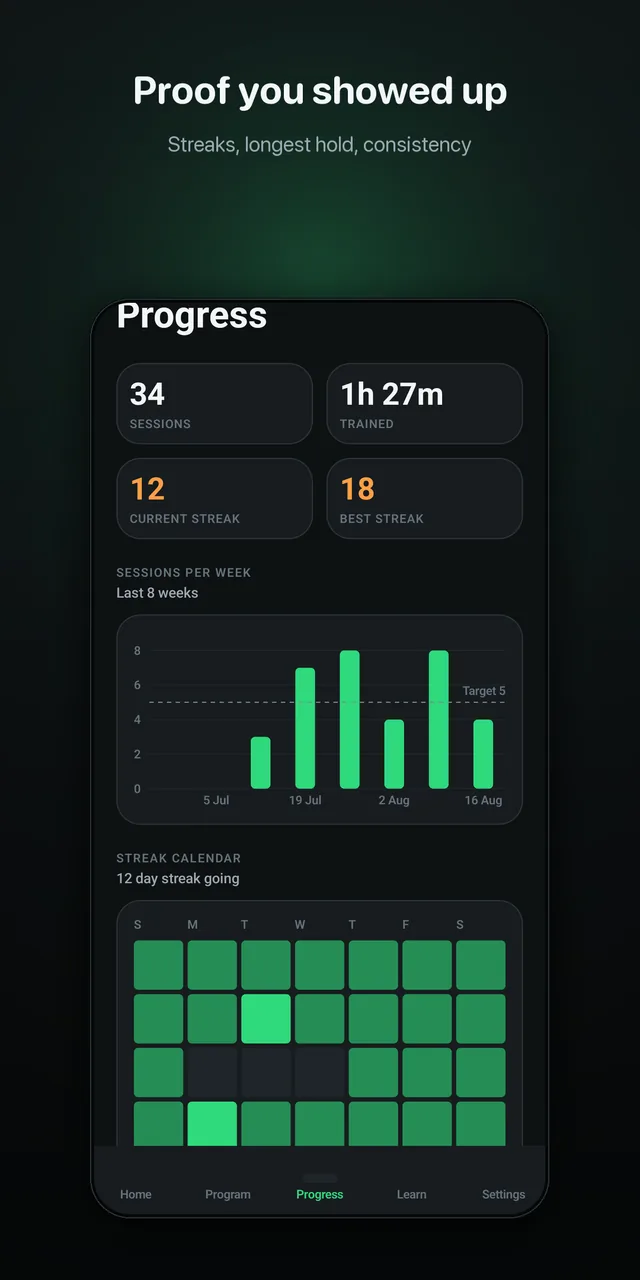
There is no way to bank missed volume. Volume caps are per day and cannot be accumulated. If you miss a day, you do not owe two the next day.
The fatigue rule
One rule overrides the numbers on screen: if you stop feeling the muscle fully release between repetitions, stop the set. That loss of release is the signal that you are done, regardless of how many reps the timer still shows. It is not cheating to end early. It is the correct response.
When to talk to a professional
Stop the session and speak to a clinician if you get pain during or after training, if you develop new pelvic aching or heaviness after sessions, or if symptoms get worse as your training volume goes up. Pelvic floor training should never hurt.