
The overall arc
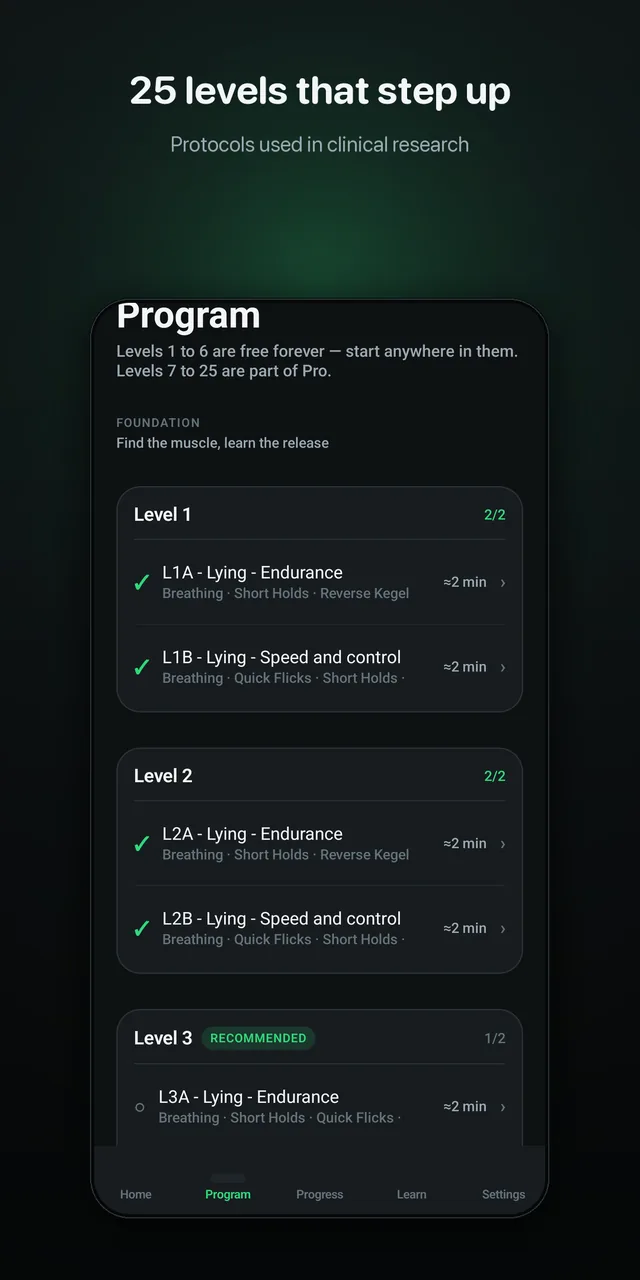
The program runs 25 levels at roughly two levels a week, which puts a full pass at about twelve and a half weeks. That is not an arbitrary length. Twelve weeks is the program duration used in Pastore 2014, Pastore 2012 and Milios 2019, and Dorey 2004 asked participants to train for at least three months before judging anything.
The levels are grouped into four phases:
- Foundation, levels 1 to 4, lying down. Easiest position to find the muscle without substituting other muscles for it.
- Build, levels 5 to 10, sitting. Slightly more postural demand, still stable.
- Load, levels 11 to 18, standing. The higher-load, more functionally relevant position.
- Command, levels 19 to 25, standing plus everyday integration. The training carries over into real situations.
That lying-to-sitting-to-standing sequence is standard in professional patient guidance and appears in the Oxford University Hospitals NHS FT 2024 leaflet as the recommended way to progress. Worth flagging honestly: Milios 2019 ran a standing-only program from day one and it outperformed a mixed-position comparison, under supervision. We progress gradually anyway, because nobody is checking your technique through a phone screen.
One variable at a time
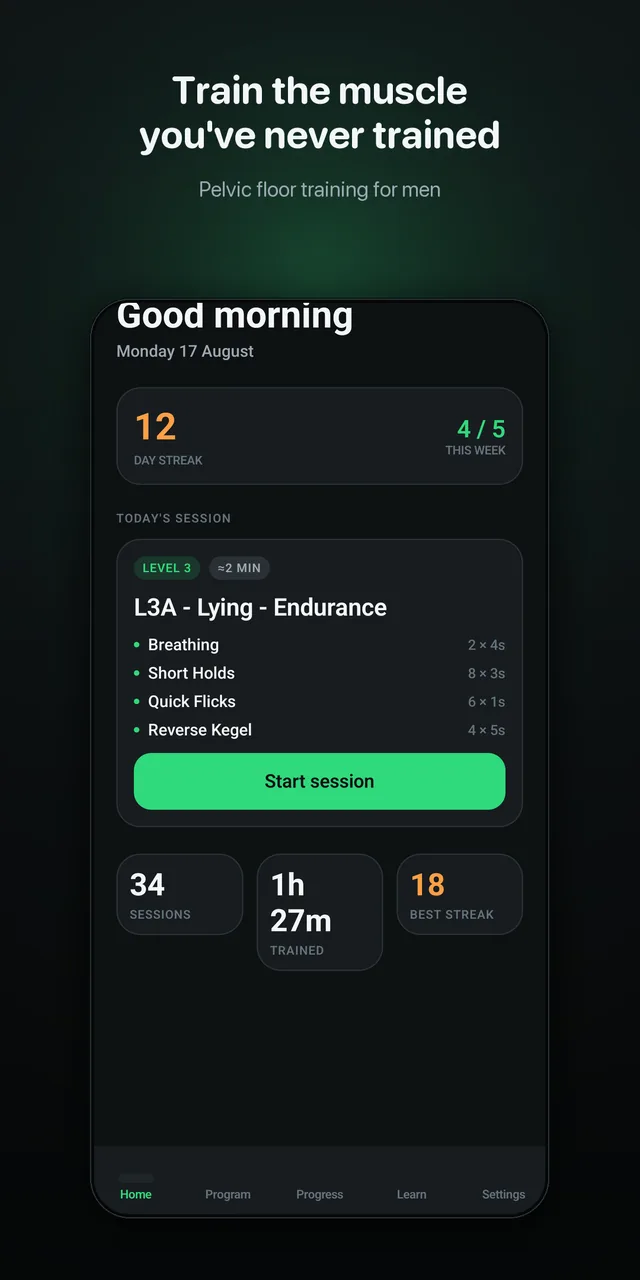
The rule the program generator obeys is simple: increase the hold length or the repetitions, never both in the same level. Holds climb from two seconds at level one to a ceiling of ten seconds late in the program. Repetitions per hold block stay between six and ten, and ten is the cap.
Ten seconds and ten reps is not a number we invented. It is the endpoint used almost universally in professional patient protocols, and no trial we drew on prescribes anything longer. When you reach it, you are at the top of the ladder.
Rest always scales with the work. Every hold gets at least as much release time as contraction time, and in the first eight levels a couple of seconds more as a cushion. Milios 2019 used equal rest periods; Dorey 2004 paired ten-second contractions with ten-second rests. Rest is never shorter than the contraction, at any level.
Why level 11 looks like a step backward
At level 11 the hold seconds stay the same as level 10 and the repetitions drop. That is not a bug. It is the cost of moving from sitting to standing being paid for. Changing position changes the load, so something else has to give for a level.
The last three levels are also numerically identical to each other. That is deliberate too. Levels 23 to 25 consolidate at the professional endpoint rather than inventing progression that the evidence does not support.
Advancement is earned, not scheduled
You do not level up because a week passed. You level up because you completed the work: at least four of your last five scheduled sessions. Miss a lot and you stay where you are, which is the correct outcome, because the next level assumes the last one actually happened.
The reverse applies as well. After a gap of a week or more, the program drops you back two levels, with a floor at the start of your current phase. After three weeks or more, it returns you to the start of your current phase. Detraining is real, and starting slightly under your last known level costs you a few days at most, while overshooting costs you technique.
There are no streaks to shame you and no backlog of missed sessions to make up. Both of those exist to drive engagement, and both push people toward exactly the overtraining pattern this program is designed to avoid.
Level 25 is not a finish line
After level 25 the program keeps running at level 25 volume, indefinitely. Professional guidance is consistent that pelvic floor training is a maintenance activity that continues long term, and Dorey 2004 explicitly prescribed a maintenance program for life after the initial phase. Muscle you stop training is muscle you eventually lose.
An honest note on the numbers
The specific level table is a defensible synthesis of the protocols in the sources behind this program. It is not "the clinically proven protocol," and you should be suspicious of anyone who tells you theirs is. Dumoulin 2011, the reference statement on this question, found that regimens across trials vary so widely that the optimal frequency and contraction count remain unresolved. Myers and Smith 2019 reached the same conclusion for men specifically: no optimal training protocol has been identified.
What we did was stay inside the ranges the published protocols use, cap everything conservatively, and design for the dose people finish rather than the dose that sounds impressive.
When to talk to a professional
Speak to your doctor or a pelvic health physiotherapist before advancing if you have had prostate surgery or have one coming up, if you get pain during or after sessions, or if your symptoms worsen as your training volume increases. Also worth an appointment if you have trained consistently for three months and nothing has changed.